
Marlborough and the Discipline of Restraint
Power, Rank, and the Formation of Men Who Can Stop

Preface: The Discipline That Makes Power Possible
The essay that follows was delivered first in condensed form, as a speech, to a room of Americans who, like many today, sense that something about power is broken.
We live in an age saturated with power—technological, economic, military—yet increasingly unable to wield it without either fear or excess. We oscillate between longing for decisive leadership and recoiling from it. We admire conquerors, study founders, debate revolution and reform, and still find ourselves stalled between paralysis and spectacle.
The question beneath all of this is rarely stated plainly: How can power be decisive without becoming sovereign?
This essay exists to answer that question.
The argument is not that power is bad, ambition should be suppressed, or hierarchy is inherently dangerous. It is the opposite. Power is real, necessary, and unavoidable—and without formation, it collapses into ego, rivalry, and tyranny.
John Churchill, 1st Duke of Marlborough, matters because he reveals a form of strength modern culture no longer knows how to see: power exercised fully, successfully, and publicly—yet restrained by rank, obedience, and self-rule. He won decisively. He wielded immense authority. And he refused sovereignty, not because he lacked opportunity, but because he was formed.
The speech presented Marlborough as a challenge. This essay explains why that challenge matters.
What follows is not nostalgia for vanished titles, nor a rejection of decisive action. It is an attempt to recover a civilizational skill we have forgotten: ranked coordination among strong men—the ability to win together without each man needing to become ultimate.
If that skill cannot be recovered, no reform will hold, no victory will last, and every rupture will collapse into personal rule.
The discipline of restraint is not the opposite of power.
It is the proof that power is real.
I. Why Marlborough, Why Now
The study of great men usually begins with a familiar cast: founders who seize cities, lawgivers who impose order, conquerors who bend the world to their will.
We read Romulus, Solon, Cyrus, Alexander, Caesar—not because they were good in every sense, but because they reveal something essential about power, ambition, and human nature. They show us what greatness looks like when it is unrestrained, and what it costs when restraint arrives too late.
Modern readers tend to assume that this story ends in antiquity.
We then leap forward—often abruptly—into modern political theory, abstract institutions, and procedural debates about power that feel disconnected from the men who actually wield it. Somewhere in between, an entire civilizational chapter is either compressed or ignored: the long experiment of Christendom, in which power was neither idolized nor abolished, but disciplined.
John Churchill, 1st Duke of Marlborough, stands squarely in that missing space. He is not ancient. He is not modern. He is not revolutionary. And for that reason, he is easy to miss.
Marlborough does not fit the dominant narratives we use to make sense of history. He did not found a city, crown himself, or overthrow a regime. He did not write a philosophy or inaugurate a new ideology. He served. He commanded. He won. And then he stopped.
This makes him less dramatic than Napoleon and less mythic than Caesar. It also makes him more difficult to categorize—and therefore easier to forget.
But forgetting Marlborough comes at a cost.
Because Marlborough forces us to confront a question that neither antiquity nor modernity answers well: What does greatness look like when power is real, dangerous, and morally accountable?
The world Marlborough inhabited was already recognizably modern. It featured standing armies, multinational coalitions, public credit, and continuous war. The machinery of large-scale power was in place. What had not yet disappeared was the expectation that the men who wielded it would be formed before they were trusted with it.
That expectation no longer feels natural to us.
We live in a world saturated with power and suspicious of authority, capable of extraordinary coordination yet increasingly unable to produce leaders who can restrain themselves once success arrives. We oscillate between fear of strong men and fascination with them, between proceduralism and spectacle, between distrust of hierarchy and longing for order.
In such a world, Marlborough is not merely an historical figure. He is a diagnostic.
He shows us what kind of man was once required to govern emerging modern power without allowing it to become tyrannical. He reveals a moral type—formed by Christianity, hierarchy, and discipline—that modern systems quietly assume but no longer reliably produce.
This essay is not an attempt to rehabilitate Marlborough’s reputation for its own sake. It is an attempt to recover a category we have lost.
If we can no longer imagine greatness without self-authorizing ambition, if we can no longer honor power that refuses to become sovereign, then we have lost more than a historical figure. We have lost a standard by which to judge both our leaders and ourselves.
What Marlborough reveals is not merely restraint, but a deeper civilizational skill we have forgotten: the ability of strong men to coordinate without competing for sovereignty. Great powers do not fall because ambition exists. They fall when ambition cannot be ordered—when every capable man must become sovereign, or else resent the order that restrains him. This essay advances a simple but dangerous claim: the highest form of power is not seizure, but the capacity to stop—and the ability to stop is downstream of a deeper skill: honoring rank so strong men can wield power together without dissolving into rivalry.
Marlborough matters now because the world he helped shape still exists—and the kind of men required to govern it are disappearing.
To understand why he was possible, why he feels implausible today, and what his life demands of us is not antiquarian interest. It is preparation.
II. Christendom and the Discipline of Greatness
The canon of great men usually moves quickly.
It begins in antiquity—with founders, lawgivers, conquerors, and heroes—and then leaps forward to modernity, where power becomes abstract, institutional, and eventually suspect. Somewhere in between, a vast chapter is skipped or treated as an embarrassment: the long moral experiment of Christendom.
This omission distorts our understanding of greatness.
The ancient world understood greatness clearly. It admired courage, ambition, honor, and the capacity to rule. Its heroes were decisive, brilliant, and often destructive. Alexander, Caesar, Alcibiades, and Cyrus differ in temperament, but they share a common moral universe: greatness is measured by expansion, domination, and the lasting imprint of one’s will on the world.
Self-rule mattered, but it was not decisive. The highest good was glory. Restraint was admirable, but not foundational. When great men stopped, it was usually because they could not continue—not because they should not.
Christianity altered this moral landscape without abolishing it.
Crucially, this was not merely institutional Christianity, but lived theology. Authority was not abstractly limited; it was personally accountable. God was not an idea at the top of the hierarchy—He was the judge before whom every act of command would eventually be weighed.
It did not deny hierarchy. It did not deny authority. It did not deny the legitimacy of rule, command, or even war. What it did was far more radical: it relocated the source of authority beyond the self and made obedience—not conquest—the highest form of moral alignment.
In doing so, Christianity introduced a new and difficult standard for greatness.
Power was no longer self-justifying. Victory was no longer proof of righteousness. Authority was no longer identical with possession. Every ruler, no matter how elevated, stood under judgment. Every act of command was provisional, accountable, and morally legible only within limits.
The Christian world still produced warriors, statesmen, generals, and founders—but it demanded something new of them: self-rule not merely as a personal virtue, but as a precondition for legitimate authority.
This is the missing chapter—without it, Marlborough appears anomalous; with it, he becomes intelligible.
Christendom created a moral framework in which a man could be ambitious without being predatory, authoritative without being absolute, victorious without being ultimate. It allowed for greatness that did not have to culminate in sovereignty.
This was not an abstract theological development. It was a lived civilizational practice.
Kings ruled but were crowned. Generals commanded but were subordinated. Offices were held, not seized. Power was exercised within a lattice of obligations—divine, moral, and institutional—that restrained even the most capable men.
Failure to respect these limits did not merely threaten order; it imperiled the soul.
This framework explains why Christendom produced figures who would have puzzled both antiquity and modernity: men who could wield enormous power and then relinquish it without theatricality or regret. Men for whom refusal was not weakness, but completion.
Even before Christianity, rare figures like Cincinnatus and Diocletian grasped this truth. Cincinnatus could return to his plow. Diocletian—still a pagan—could abdicate an empire. Marlborough could accept a dukedom and no more. Washington could resign his commission.
Christianity made this logic normative and civilizational—turning rare flashes into an expectation, naming it, and installing it into the moral architecture of authority.
Modernity, having rejected this framework, struggles to understand what it has lost. It often mistakes Christian restraint for timidity, obedience for servility, and refusal for lack of ambition. In doing so, it oscillates between two unsatisfying poles: either romanticizing ancient conquest or distrusting power altogether.
Christendom offered a third way.
It did not eliminate greatness. It taught greatness where to stop.
Marlborough stands precisely at this juncture. He is not an ancient hero, driven by glory. He is not a modern strongman, driven by self-authorization. He is a Christian commander, formed by a world that believed power was real, dangerous, and answerable to God.
That world has faded, but its artifacts remain—in institutions, in traditions, and in rare lives that still point toward it.
To recover Marlborough is not merely to recover a man. It is to recover a lost moral category: greatness under obedience.
Without that category, the rest of our judgments about power collapse into confusion.
III. Marlborough as a Type, Not a Curiosity
Marlborough often strikes modern readers as implausible.
His combination of traits—ambitious yet obedient, powerful yet restrained, victorious yet unwilling to seize—feels so rare that the temptation is to treat him as a historical curiosity. A fortunate anomaly. A moral outlier. A man who happened, by chance, to be better than his circumstances.
This reaction is understandable—and mistaken.
Marlborough is rare now. He was not rare then.
To see him clearly, we must shift our attention away from his brilliance and toward his formation. Greatness alone does not explain him. Many men have been brilliant. Few have been governed.
Marlborough did not rise because he was born to rule. He was not royal. He did not possess a revolutionary ideology or a messianic sense of destiny. He emerged from the minor gentry—aristocratic enough to be shaped by honor and expectation, but constrained enough to learn patience, loyalty, and discipline.
This matters.
His ambition developed inside a world that expected restraint as a condition of trust. Authority was real, but it was layered. Offices had ceilings. Advancement required service, not transgression. Power was something one entered into, not something one seized outright.
In other words, Marlborough was formed inside a civilizational ecology that could produce a specific type of man.
That type deserves to be named.
Marlborough is best understood not as a “hero” or a “strongman,” but as a Christian gentleman-commander—a steward of power rather than its source. This type was not unique to him. It appeared across Christendom wherever hierarchy, duty, and obedience were still taken seriously.
The gentleman-commander is ambitious, but not resentful. He seeks excellence, but not ultimacy. He desires honor, but understands that honor is conferred through service, not self-assertion. He is capable of command, yet comfortable with subordination. He respects hierarchy without fetishizing sovereignty.
Most importantly, he does not experience limits as insults.
This is the decisive difference.
The gentleman-commander understands that authority is something one holds, not something one becomes. Office does not fuse with identity. Rank does not absorb the soul. Power is exercised with the awareness that it is provisional and accountable—to God, to institutions, and to a moral order that precedes the self.
This posture makes ranked coordination possible. Marlborough’s greatness does not lie in solitary dominance, but in his capacity to operate inside a hierarchy of other powerful men—princes, generals, ministers—without collapsing the system into ego warfare. He could lead. He could submit. He could command without needing to become sovereign. This is not weakness. It is the operating system of durable power.
Marlborough embodies this posture so completely that it becomes easy to overlook how demanding it is.
He negotiates with princes without envying them. He commands armies without imagining himself a king. He accepts elevation without allowing elevation to redefine who he is. His loyalty is not servile, because it is not rooted in fear. It is principled, because it is rooted in order.
This type of man cannot be produced by talent alone. He requires a culture that honors hierarchy without absolutizing it, ambition without unmooring it, and authority without idolizing it.
Modernity struggles to produce such men because it has quietly dismantled the conditions that formed them—while continuing to assume the virtues those conditions produced.
When the self becomes sovereign, obedience is recast as weakness. When authenticity replaces duty, ambition loses its ceilings. When limits are interpreted as oppression, restraint becomes unintelligible. In such a world, power either explodes outward into domination or collapses inward into suspicion.
Neither outcome can sustain stewardship.
This is why Marlborough feels alien to us. Not because he was unreal, but because the civilizational machinery that once produced his type has largely fallen silent.
His disappearance is not evidence of his uniqueness. It is evidence of our deformation.
Seen this way, Marlborough’s life does not invite mere admiration. It issues a quieter, more uncomfortable challenge.
If such a type once existed, it can exist again. And if it can exist again, responsibility follows.
The question is no longer whether greatness under restraint is possible.
It is whether we are willing to rebuild the conditions that make it so.
IV. Self-Rule as the Axis of Judgment
Plutarch did not ask whether a man was brilliant.
He asked whether a man ruled himself.
This distinction is easy to miss, especially in ages that admire spectacle. Great victories, daring campaigns, bold reforms, and sweeping ambition draw the eye. They impress the crowd. They make history dramatic. But Plutarch’s concern was quieter and more severe. He understood that the most important battles occur before an army is ever commanded.
They occur within the soul.
Self-rule is not the same as temperament. It is not calmness by nature, nor politeness, nor the absence of passion. It is the capacity to govern impulse, ambition, resentment, and fear—especially under conditions of success.
This is why Plutarch paired lives rather than ranking them. He was less interested in outcomes than in orientation. He wanted to know what kind of man power revealed once it was present in abundance.
Seen through this lens, many of history’s most dazzling figures fail.
Alcibiades possessed brilliance without discipline. His gifts were real, but his self-rule was thin. Success amplified instability rather than mastery. He could persuade cities, sway assemblies, and charm allies, but he could not govern desire. His life shows what happens when ability outruns restraint: talent becomes dangerous, and promise curdles into betrayal.
Self-rule, at its highest level, is not merely mastery of impulse, but the ability to accept a limit that one does not personally command.
Caesar ruled others superbly but could not accept limits imposed from outside himself. His virtues were genuine—clemency, courage, strategic clarity—but they were subordinated to a will that could not stop. The Republic fell not because Caesar failed, but because once institutional restraint had hollowed out, there was no longer a rank beneath sovereignty in which greatness could rest.
In each case, the failure is not lack of greatness. It is lack of self-rule—not in the sense of indiscipline, but in the inability to submit to a limit that does not originate in the self.
Christianity sharpened this ancient insight and made it decisive. It did not invent the idea that men should govern themselves. It made self-rule the moral condition of legitimate authority. Power without mastery of the self became not merely dangerous, but disordered.
Marlborough passes this test.
His self-rule is visible not in dramatic renunciations, but in habits: patience with allies, restraint under provocation, discipline amid acclaim, and steadiness in the face of suspicion. He governs himself before he governs others. He does not need to dramatize restraint because it is already present.
This quality matters most when a man is winning.
Defeat often enforces restraint automatically. Victory removes those constraints. It excites the passions, invites excess, and tempts the successful to interpret momentum as mandate. The ability to remain governed internally when external checks fall away is rare—and it is the true measure of command.
Marlborough’s refusal to convert success into sovereignty is not a single heroic moment. It is the natural consequence of a life already ruled.
This is why self-rule scales.
The same discipline that governs a man’s tongue in moments of irritation governs his judgment in moments of power. The same restraint that allows him to absorb insult without retaliation allows him to absorb acclaim without intoxication. These are not separate virtues. They are the same virtue applied at different magnitudes.
A man who cannot rule himself in small matters cannot be trusted with large ones. A man who cannot govern his passions will eventually govern others unjustly. Institutions magnify character; they do not correct it.
We design procedures, safeguards, and abstractions to compensate for moral weakness, hoping structure will restrain what formation did not. Sometimes this works—for a time. Eventually, it does not.
The system meets a man strong enough to exploit it and insufficiently formed to resist doing so. Plutarch would not be surprised.
Self-rule is therefore not an optional adornment of leadership. It is its foundation. Without it, power becomes predatory or unstable. With it, power becomes intelligible, durable, and capable of being relinquished.
This is why Marlborough can stop.
He does not need to test the limits of his authority because he already knows where the limits are. He does not need to prove himself through possession because his identity is not dependent on expansion. He governs others because he governs himself.
In this sense, self-rule is not merely a private moral achievement. It is a public good.
Civilizations that elevate men without it produce spectacle and collapse. Civilizations that demand it produce quieter greatness—and institutions that can survive their founders.
Plutarch understood this. Christianity enforced it. Marlborough embodied it.
Without self-rule, history becomes a parade of brilliant men who burn everything they touch.
With it, power can finally serve something other than itself.
V. The Birth of the Modern State—and Why It Was Dangerous
Before Marlborough, war was brutal—but it was limited.
Armies were seasonal. Campaigns were short. Financing was personal, episodic, and fragile. Kings borrowed against their own estates. Victories were often paid for by plunder, ransom, or the exhaustion of local resources. When money ran out, wars ended—not because peace was achieved, but because continuation became impossible.
This constraint was crude, but it was real.
The wars Marlborough fought shattered it.
The War of the Spanish Succession was not a dynastic skirmish. It was a continental struggle over balance, legitimacy, and survival. It required armies that could be sustained year after year, across borders, through winter and defeat. It required coalitions of sovereign states with competing interests. And it required a financial apparatus capable of enduring strain without collapse.
Plunder would not suffice. Taxes alone would not suffice.
For the first time, the state itself had to become a credible, continuous borrower.
This is the moment at which the modern state truly begins.
The creation of public credit—most notably through the Bank of England—was not a philosophical innovation. It was an operational necessity. England needed a way to finance long-term war without either bankrupting the crown or reverting to tyranny. Investors lent not to a king as a person, but to a state as an institution—one backed by law, Parliament, and continuity.
This changed everything.
Power became scalable. War became continuous. Authority became abstract. The state could now act far beyond the lifespan, fortune, or temperament of any single ruler.
This was an extraordinary achievement. It was also profoundly dangerous.
A system capable of sustaining war indefinitely is also capable of consuming everything beneath it. Standing armies and public credit sever power from natural limits. They allow ambition to persist long after prudence would have intervened. They magnify the consequences of error and amplify the character of those who command them.
Once such a system exists, the decisive question is no longer technical. It is moral.
What kind of man can be trusted to wield power that no longer exhausts itself?
Marlborough was the first to face this question in full.
He did not design the modern state in theory. He operated it in practice. He commanded armies that could not simply disband. He coordinated finances he did not personally control. He exercised authority that no longer ended naturally with a campaign season or a depleted treasury.
In other words, he wielded power that could continue even if he did not.
This is precisely why self-rule became decisive.
A man who cannot stop when limits disappear will push until collapse. A man who interprets momentum as mandate will convert operational capacity into personal destiny. A man who treats victory as authorization will inevitably attempt to become sovereign.
History is filled with such men.
Marlborough was not one of them.
He treated the new machinery of power as a trust, not an extension of the self. He understood that just because a system could continue did not mean it should. He subordinated operational possibility to moral judgment.
This restraint was not enforced by structure alone. Structures can be bent. It was enforced by character.
The irony is sharp: the modern state required unprecedented restraint precisely because it had removed so many external restraints. Where ancient power was checked by scarcity, modern power must be checked internally.
This is why the moral formation of leaders suddenly mattered more than ever before.
Napoleon would later inherit this same machinery—standing armies, public credit, mass mobilization—but without the Christian discipline that had restrained it. He would demonstrate, with terrible clarity, what happens when modern power meets self-authorizing ambition.
Marlborough demonstrated the alternative.
He showed that the modern state could be wielded without becoming absolute, that war could be fought without devouring the order it claimed to defend, and that victory need not culminate in sovereignty.
The tragedy is not that the modern state exists.
The tragedy is that we built it before ensuring we could still form the kind of men required to govern it.
Marlborough stands at the moment when that formation still existed.
The question that follows us now is whether it still can.
VI. Napoleon vs. Marlborough: Two Ways Power Ends
History remembers Napoleon because he crowned himself.
It remembers the image vividly: the pope present, the ceremony prepared, the crown raised—and then Napoleon placing it on his own head. The gesture was unmistakable. Authority no longer descended; it originated in the self. Destiny was no longer received; it was asserted.
This single act contains an entire anthropology.
Napoleon is the purest expression of modern greatness: self-authorizing, world-historic, incandescent. He rises by talent, force of will, and battlefield genius. He smashes an old order that deserved to fall and replaces it with himself. Institutions orbit him. Meaning flows outward from his person. He becomes the measure of legitimacy.
It is impossible not to admire him.
It is also impossible for such a model to endure.
Napoleon’s power could not stop. It required constant motion—victory to justify authority, expansion to justify rule, war to justify destiny. Peace was not an end; it was a threat. The moment motion ceased, legitimacy would have to be grounded somewhere other than the self, and that was impossible.
So the wars continued. So the order consumed itself. So the system collapsed when the man fell.
Marlborough stands in stark contrast.
He never made a spectacle of himself. There is no single image that defines him in the popular imagination—no coronation, no dramatic seizure, no theatrical self-mythologizing. He is harder to remember precisely because he refused to condense authority into a moment.
And yet his power was no less real.
What made restraint meaningful was not that Marlborough lacked opportunity. It was that the opportunity was obvious. He had the army’s loyalty. He had public acclaim. He had momentum. Everyone knew it. Restraint only counts when seizing would have been easy—and applauded.
Marlborough commanded coalition armies on a continental scale. He fought wars just as complex, just as brutal, and arguably more consequential for the future of Europe. He coordinated coalitions of sovereign states, navigated fragile alliances, and defeated the most powerful monarch of his age.
The difference is not capacity. The difference is culmination.
Napoleon’s story climaxes in possession. Marlborough’s climaxes in restraint.
Where Napoleon converts victory into sovereignty, Marlborough converts victory into stability. Where Napoleon becomes the state, Marlborough strengthens the state and remains subordinate to it. Where Napoleon must rule to justify himself, Marlborough rules without needing to rule over all.
This is not a difference of personality alone. It is a difference of moral structure.
Napoleon embodies power that authorizes itself. Marlborough embodies power that understands itself as delegated. One treats authority as proof of worth; the other treats authority as a trust that can be revoked.
This distinction explains everything that follows.
Napoleon builds an order that cannot survive his absence. Marlborough helps build an order that outlives him. Napoleon leaves monuments of memory—names, myths, legends. Marlborough leaves institutions.
The modern world is drawn irresistibly to Napoleon because it recognizes itself in him—the same anthropology: the self as source, the will as justification, identity as destiny.
Marlborough feels alien for the same reason.
He represents a model of greatness that does not flatter the self. His authority does not crescendo into ultimacy. His ambition does not demand apotheosis. He does not need to become history’s axis to know his life was complete.
This makes him harder to admire—but far more important to understand.
Because the real question is not which man was greater in the moment. The question is which model of power can found something that lives.
Napoleon’s model produces brilliance, speed, and collapse. Marlborough’s produces continuity, succession, and peace. One dazzles. The other endures.
History remembers Napoleon because he seized the crown. It forgets Marlborough because he didn’t.
But only one of them left behind a world capable of continuing without him.
And that difference—more than any battlefield victory—is what separates conquest from founding.
VII. Life Is Good as a Duke
Modern culture struggles to imagine authority that does not seek to become sovereign.
We are trained—almost from birth—to believe that power naturally culminates in possession: that if a man has the strength to take the crown, he will; and if he does not, it is because he cannot. Restraint is read as weakness. Obedience is mistaken for fear. Submission is treated as humiliation.
This anthropology quietly governs everything from politics to business to personal ambition. It is the logic of the founder who must become king, the general who must rule, the revolutionary who cannot stop. It is also why figures like Napoleon remain endlessly fascinating, while men like Marlborough fade from view.
And yet Marlborough forces an uncomfortable realization: life is good as a duke.
This is not a statement of diminished ambition. It is a statement about rightly ordered ambition—about power exercised fully, competently, honorably, and within limits. Marlborough rose to extraordinary authority: vast armies, coalitions of rival princes, wars of unprecedented scale. He was celebrated publicly, granted estates, and elevated to the highest rank short of sovereignty. At several points in his career, he could plausibly have seized more.
Everyone knew it. That is precisely why the refusal mattered.
Marlborough did not lack power. He lacked the need to convert power into possession. He understood that authority does not increase simply because one grasps more of it. Past a certain point, it curdles.
The duke occupies a morally intelligible position. He has real command, real responsibility, real dignity. He stands above most men, but below the throne. He governs without needing to be ultimate. His authority is intelligible precisely because it is bounded.
Gibbon often ends his judgments with a quiet phrase: “the man attained a respectable rank.” Modern readers miss the praise embedded there. A respectable rank meant authority exercised without resentment, ambition disciplined by duty, and power held without the need for ultimacy. Civilizations depend on men who can inhabit such ranks with honor.
A civilization cannot be run by kings alone. It survives because many strong men accept respectable rank—because they can look up without resentment, look down without contempt, and stand shoulder-to-shoulder without each demanding ultimacy. This is how power scales. This is how regimes are broken without collapsing into warlords. This is how victory becomes order.
Marlborough lived in a world that still understood those gradations.
He served kings without being servile. He commanded princes without resenting them. He exercised immense authority without needing to sacralize himself. His ambition was not annihilated by obedience; it was disciplined by it.
This is where the Christian moral architecture becomes decisive.
Marlborough’s letters are saturated with an awareness that his authority was not self-generated. His correspondence returns again and again to providence—victories attributed not to brilliance, but permission; success framed not as entitlement, but mercy. “If God wills it” was not rhetoric. It was orientation. Victory, when it came, was attributed to Providence. Failure, when it came, was borne without theatrical despair. Power was treated not as an extension of the self, but as a trust temporarily placed in his hands.
That posture made restraint possible.
A man who believes that all authority ultimately belongs to God does not experience limitation as an insult. He experiences it as truth. He does not need to seize what is not his, because his worth does not depend on becoming the source of order.
This is why Marlborough could stop.
Stopping is harder than winning.
Winning excites the passions. It invites the crowd. It produces momentum. The temptation is always to convert success into permanence, to turn victory into rule, to justify seizure as necessity. History is crowded with men who crossed that line and were applauded for it—until they weren’t.
Marlborough never crossed it.
He accepted the dukedom not as consolation, but as fulfillment. He did not see it as “less than” a crown. He saw it as appropriate. His life testifies to a truth modern culture resists: not every great man must be king.
There is a profound difference between authority exercised well and authority accumulated without limit. The former builds institutions. The latter consumes them. The former leaves room for succession. The latter leaves only collapse or stagnation.
This is why Marlborough is more than a historical curiosity. He represents a form of greatness that modern founder-myths cannot comprehend: greatness that does not require ultimacy.
“Life is good as a duke” is therefore not resignation. It is maturity.
It is the recognition that a man’s highest dignity lies not in possessing everything, but in ruling what he has been given—well, fully, and without resentment. It is the acceptance of hierarchy without bitterness, ambition without envy, obedience without humiliation.
This posture is alien to a culture obsessed with the self. But it is indispensable to any civilization that hopes to last.
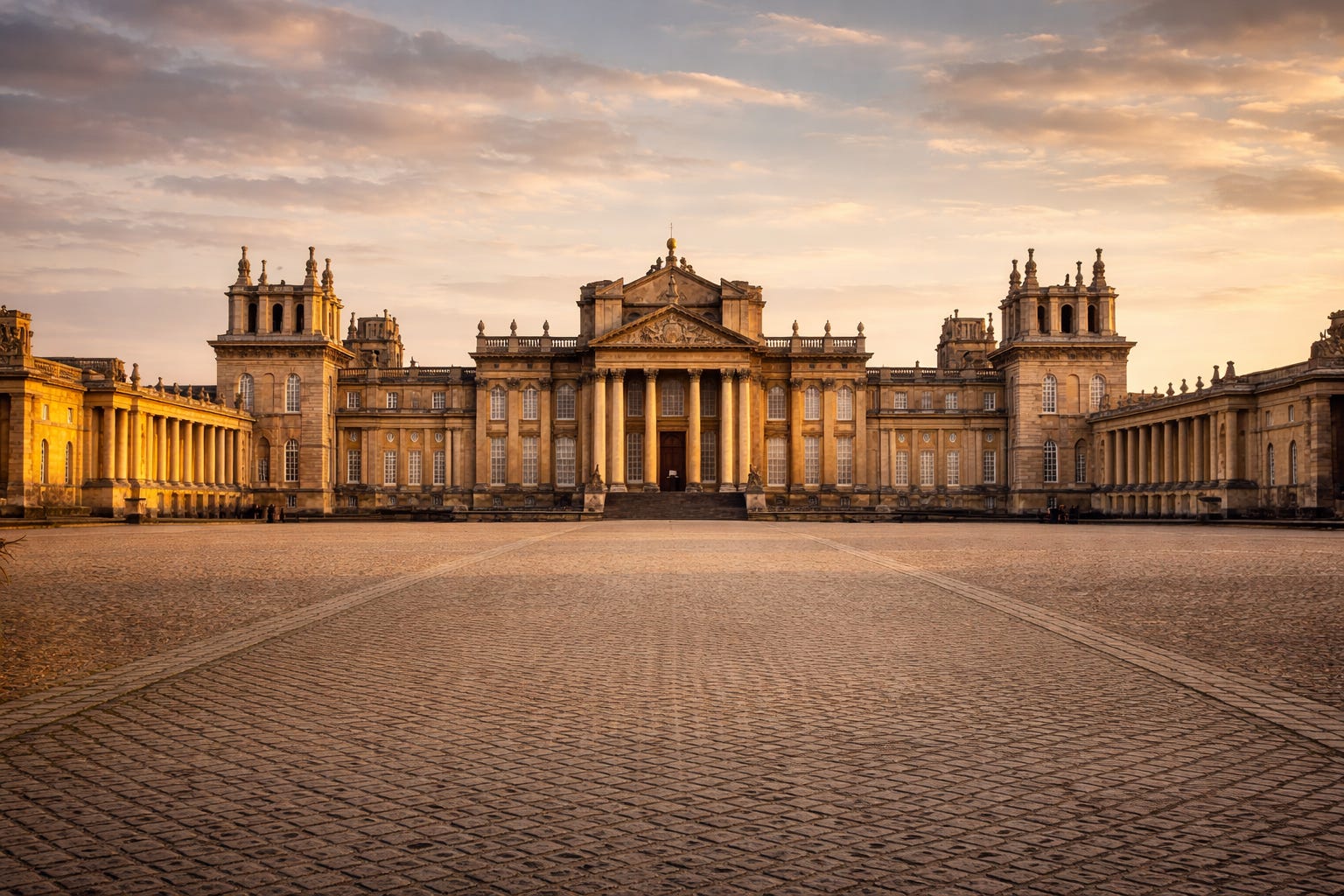
Marlborough’s world could build Blenheim Palace because it believed in continuity—because it trusted that posterity would recognize the difference between conquest and stewardship.
And yet the need has not gone away.
Institutions still require men capable of wielding power without worshiping it. Armies, corporations, states, and families still depend on leaders who can stop—who do not need to crown themselves to feel real.
Marlborough shows that such men can exist.
He does not dazzle like Napoleon. He endures. He does not dominate history by spectacle. He shapes it by restraint. He does not found by seizure. He founds by service.
Life was good as a duke—because the duke knew who he was, who he served, and where authority properly ended.
That knowledge may be rarer now than power itself.
VIII. Washington and the American Inheritance of Restraint
George Washington is often treated as an exception. An admirable anomaly. A fortunate accident. A singularly virtuous man who somehow appeared at the founding of a republic and then, inexplicably, walked away from power.
This framing flatters us, but it is wrong.
Washington was not an exception. He was an heir.
To understand Washington rightly, we must recover the tradition he stood within—a tradition of restrained authority that predates America and that Marlborough exemplifies with unusual clarity.
Washington was trained as a British officer. He absorbed the moral and military norms of an English world that still understood hierarchy, duty, and obedience as virtues rather than constraints. He did not emerge from a vacuum. He emerged from a culture that expected commanders to serve the civil order, not replace it.
Marlborough was part of that inheritance.
He was not a distant classical figure, but a relatively recent exemplar—dead only a generation before Washington’s birth, his campaigns still studied, his name still synonymous with disciplined command. For the British officer corps, Marlborough represented the highest form of military excellence precisely because he had refused sovereignty.
Washington would have known this world instinctively, even if he never consciously imitated Marlborough in detail. They were formed by the same moral grammar.
This matters, because Washington’s greatness does not lie in what he could have done, but in what he refused to do.
Like Marlborough, Washington commanded armies. Like Marlborough, he navigated coalitions, rivalries, shortages, and exhaustion. Like Marlborough, he was celebrated publicly and trusted widely. And like Marlborough, there were moments—real moments—when power could have been consolidated permanently in his hands. He lacked the desire to transgress.
Washington’s resignation of his commission was not an act of theatrical humility. It was an act of fidelity to a moral order he believed was real. He did not see authority as something that accrued to the self by virtue of success. He saw it as something entrusted temporarily, for a purpose, under judgment.
That judgment did not come from the crowd.
It came from God, from conscience, and from a civilizational inheritance that taught him a hard lesson: power that cannot be returned will eventually destroy what it claims to protect.
This is why the comparison to Napoleon is so revealing.
Napoleon crowned himself because his authority required confirmation from no one higher than himself. Washington returned his commission because his authority was intelligible only within limits. Napoleon’s greatness culminated in possession. Washington’s culminated in relinquishment.
But relinquishment is only meaningful if possession was possible.
Washington’s refusal matters because everyone knew he could have taken more. That knowledge—shared by allies and rivals alike—is what makes the restraint legible. Without that background of real power, refusal would be sentimentality.
It was not sentimentality. It was self-rule.
Washington belongs, therefore, in a lineage that modern culture rarely names but instinctively recognizes when it sees it: Cincinnatus returning to his plow; Diocletian stepping away from the imperial throne; Marlborough accepting the dukedom and no more.
These men are not weak. They are finished.
They do not need to climb further because they have reached the point at which ambition must either be disciplined—or become corrosive.
Modern America struggles to see Washington clearly because we no longer live comfortably inside this moral framework. We prefer founders who seize, disrupt, and transcend. We are suspicious of hierarchy, skeptical of obedience, and deeply uncomfortable with the idea that authority might be good precisely because it is bounded.
Marlborough helps us recover Washington by reminding us that refusal was once a normative expectation of greatness, not a miraculous exception.
Washington was not great because he walked away from power.
He was great because he knew when power had done its work.
That knowledge—more than any battlefield success—is what allowed the American republic to begin without collapsing immediately into either tyranny or chaos. It is also what allowed its institutions to outlive the man who first embodied them.
In that sense, Washington is not merely America’s founder. He is its first steward.
And Marlborough, standing just behind him in history, helps us see that this stewardship was not naïve, accidental, or uniquely American. It was inherited.
The tragedy is not that we have forgotten Marlborough.
The deeper tragedy is that, in forgetting the tradition he represents, we have begun to forget Washington as well—not as a statue or a slogan, but as a model of how power ought to end.
IX. Memory, Stone, and Time Horizons
Civilizations reveal what they value by what they choose to remember—and by how they remember it.
Some preserve memory in words, others in ritual, others in stone. The form matters, because it reveals a culture’s confidence in its judgments and its expectations of the future. To build in stone is to assume that posterity will still care—that it will recognize meaning rather than erase it.
Blenheim Palace is such an act.
It is not merely a reward for military success. It is a declaration of civilizational confidence: that Marlborough’s restraint, service, and victories were worthy of being judged across centuries. Its builders assumed continuity. They believed that future generations would understand the difference between conquest and stewardship, between seizure and service.
Modern culture hesitates to do this.
We memorialize with content, not stone. We rename rather than build. We preserve narratives provisionally, always with an eye toward revision. This is not humility. It is uncertainty—a quiet admission that we do not trust our own judgments to endure.
Blenheim was built by a world that still trusted itself.
This difference reflects a deeper divergence in time horizons. Christendom assumed that human action participated in a longer moral story—one that extended beyond individual lives and immediate outcomes. Authority was exercised with an awareness of inheritance and succession. Memory mattered because continuity mattered.
Marlborough’s world expected judgment to come not only from contemporaries, but from history and from God.
That expectation shaped behavior.
A man who believes his actions will be weighed by posterity—and not merely celebrated by the crowd—acts differently. He resists theatricality. He favors durability over spectacle. He seeks alignment with enduring standards rather than immediate acclaim.
This helps explain Marlborough’s restraint as much as any personal virtue.
He did not need to mythologize himself because his culture did not require self-mythologizing for legitimacy. Memory was collective, not personal. Meaning was conferred through institutions, not seized through image.
Modernity inverted this relationship.
We increasingly expect memory to be unstable, judgment to be contested, and meaning to be temporary. As a result, leaders are tempted to force permanence through spectacle—through domination of narrative, image, and attention. When stone is no longer trusted, performance replaces it.
This is why modern power gravitates toward excess.
The shortness of our time horizons encourages self-authorization. If the future will not judge fairly, the present must be conquered completely. If memory is fragile, the self must become the monument.
Napoleon understood this instinctively. His legacy rests on image, legend, and historical fixation. Marlborough’s rests on institutions and stone.
One dazzles. The other endures.
It is worth noticing that the greatest surviving monuments of civilization rarely commemorate self-crowning figures. They commemorate orders, offices, and achievements that outlived the men who initiated them. Stone remembers what spectacle cannot.
This does not mean words are unimportant. Homer endures where palaces crumble. But even Homer presupposes a culture confident enough to transmit judgment faithfully across generations. Words endure only when a people believe they are worth preserving.
Blenheim stands because a civilization believed that restrained power was worth remembering.
The decline of such confidence has consequences. When societies lose faith in long-term judgment, they lose the ability to form leaders for the long term. Authority becomes provisional. Legitimacy becomes performative. The future becomes an enemy rather than a judge.
Marlborough’s restraint makes sense in a world that expects continuity. It becomes unintelligible in a world that doubts it.
This is why memory matters to power.
If we no longer build for posterity, we should not be surprised when leaders govern only for themselves. If we no longer trust history to judge wisely, we will seek to settle all judgment in the present—by force, by narrative, or by seizure.
Blenheim is not merely a palace. It is a question carved in stone: Do we believe our civilization will still exist—and still know what greatness looks like—when we are gone?
Marlborough’s world answered yes.
Whether ours still can remains an open question.
X. The Real Crisis: Formation
At this point, the problem should be clear. It is not that power exists. It is not that institutions endure. It is not even that the modern state has grown dangerous.
The real crisis is that we no longer reliably form the kind of men required to govern what we have built.
Formation is the missing layer that makes restraint possible and coordination sustainable. Without it, power fragments into personal sovereignty—every man a king, every hierarchy unstable.
Formation is the process by which men learn to inhabit rank. It produces leaders who can command and submit, who can wield power without demanding sovereignty, and who can coordinate strength rather than fragment it. Without formation, every strong man becomes a rival. With it, strength compounds.
This is a failure of formation, not of intelligence or capacity.
Modern societies are excellent at producing specialists. We train men to optimize systems, manipulate abstractions, and operate machinery of immense complexity. We reward initiative, ambition, and disruption. We elevate talent quickly and often detach it from moral apprenticeship.
What we do not consistently produce are men who can stop.
As we saw in the birth of the modern state, external limits have thinned; restraint must now be internal. When limits disappear, either men govern themselves—or the system consumes everything.
Marlborough’s world still understood this. It expected formation before authority. It assumed that men would be shaped long before they were entrusted with command. Character was not an accessory to leadership; it was its precondition.
That expectation has weakened.
We increasingly assume that systems can compensate for moral deficiency—that procedures can replace virtue, that incentives can substitute for judgment, and that guardrails can restrain what formation did not. For a time, this works. Eventually, it does not.
When systems fail, they fail catastrophically.
History’s pattern is consistent. Civilizations collapse not when they lose talent, but when talent outruns restraint. They do not fall because strong men appear, but because strong men appear without limits—and because no one has taught them where to stop.
This is why nostalgia is not the answer.
We do not need to resurrect dukedoms, crowns, or vanished institutions. We need to recover the formative logic that made restrained authority possible within them. Without that logic, restoring forms merely accelerates decay.
Formation is slower than reform. It is quieter than revolution. It does not produce immediate spectacle. But it is the only process that scales with power rather than being overwhelmed by it.
To form men capable of restraint requires a culture willing to teach uncomfortable lessons: that ambition must be trained before it is unleashed, that obedience is not humiliation, that hierarchy can be good without being absolute, that self-rule precedes legitimate rule.
These lessons cannot be learned in moments of crisis. They must be habituated long before power arrives.
This is why Marlborough matters now.
He reminds us that greatness under restraint is not an abstract ideal, but a lived possibility—one that once governed real armies, real states, and real institutions. He shows that obedience to God and service within hierarchy do not diminish authority; they make it intelligible.
The disappearance of such men is not inevitable. It is the result of choices—educational, cultural, and moral—that deprioritized formation in favor of expression, acceleration, and scale. Modern systems quietly assumed they could inherit the virtues of an older order without continuing to produce them.
Those choices can be reversed.
But reversal will not come from ideology alone. It will come from communities, traditions, and institutions willing to form men patiently—men who can govern themselves, honor limits, accept rank, and wield power without needing to become sovereign.
Until that work resumes, debates about power will remain confused—because men who cannot honor rank will always misread authority. We will oscillate between fear of authority and longing for it. We will denounce strong men while secretly hoping one will save us.
Marlborough offers a better path.
He does not promise safety. He demands formation. He does not flatter the self. He disciplines it. He does not abolish power. He teaches it where to end.
If we want institutions that live, we must once again form men who can stop.
Everything else is noise. Noise cannot build what must endure.